📌 Key findings of this study; teenagers use AI as emotional support⚪️ 31% of UK children have talked to an AI chatbot about how they were feeling before speaking to a parent, friend or teacher,⚪️ School pressure is the number one personal topic teens bring to a chatbot, ahead of friendships and family issues, ⚪️ 73% of children who got emotional advice from a chatbot went on to follow it in real life, ⚪️ More than a third of them never told a trusted adult afterwards, ⚪️ Only 35% of parents say their child has ever mentioned talking to a chatbot about their feelings, ⚪️ 88% of parents want under-16s to need consent, or to be banned outright, from using AI chatbots such as ChatGPT. |
Somewhere between the school run and bedtime, a lot of UK teenagers are having a conversation their parents don't know about. It isn't with a friend down the street or a older sibling. It's with a chatbot on their phone.
That's the picture emerging from the new GoStudent survey of 500 UK parents (aged 26+) and their children (aged 11 to 17), carried out by Censuswide between 16 and 23 June 2026. The study looks at teenagers using AI chatbots for everything from homework help to using ai for emotional support, and lines it up against what parents actually know about it.
The headline isn't that teenagers are using AI. Most families already assume that. It's what they're using it for, and how often that use happens quietly, one step removed from any adult in their life.
This article walks through what UK children and parents told us, section by section, with the real numbers behind each finding. We also share some simple advice and best practices we can be learn in order to be present and support the children who need it, for both families, teachers and tutors.
Using AI for emotional support : the chatbot as a first confidant
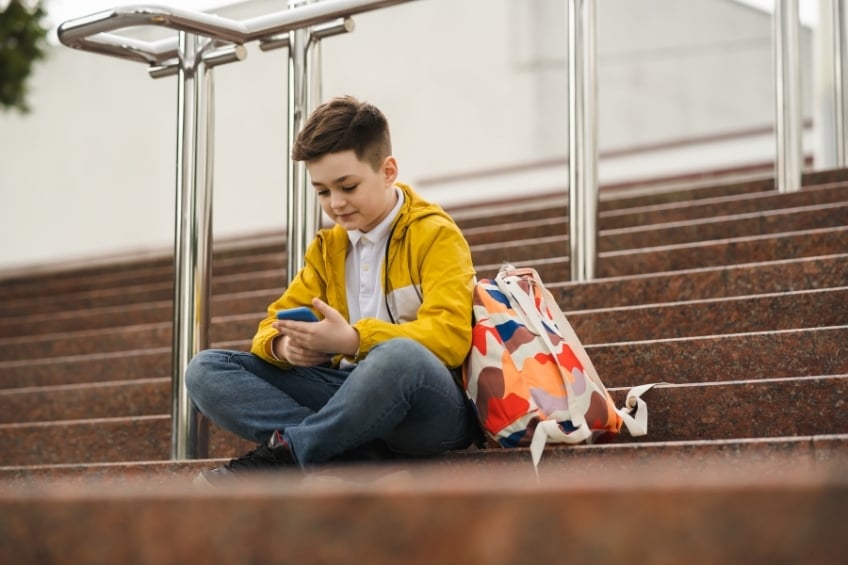
The most striking finding in the whole study is about order. We didn't just ask whether children have used a chatbot to talk about their feelings. We asked whether they'd done it before speaking to a parent, friend, teacher or anyone else.
31% said yes. Of those, 20.8 percentage points said this has happened more than once, not a one-off moment of curiosity.
|
Response |
Share of children |
|
Yes, this has happened more than once |
20.8% |
|
Yes, this has happened once |
10.2% |
|
No, always speaks to people first (but has used a chatbot for this) |
16.8% |
|
Has used an AI chatbot before, but never for this |
30.4% |
|
Has never used a chatbot for this reason, or never used AI at all |
21.8% |
Picture a 14-year-old who's just had a rough day, a friendship fallout, a bad grade, a disagreement with a teacher. The old default was to sit with it until a parent asked "how was school?" at dinner. Now, for roughly a third of UK children, the first person they "tell" is an app that never asks how their day was first. It's simply there, instantly, with no risk of a follow-up question they're not ready for.
That's not necessarily a red flag on its own. But it does mean a meaningful share of teenagers using AI chatbots are routing their first emotional reaction through a machine, not a relationship, and that has consequences for how quickly a struggling child gets real support. It's also worth noting that a further 30.4% of children have used an AI chatbot before, just never for this, a reminder that most of what's driving chatbot use among teenagers isn't emotional at all, and that the "first confidant" pattern, while real, sits within a much larger group of everyday, low-stakes use.
What teenagers actually bring to the chatbot
When children who'd used a chatbot for something personal were asked what it was mainly about, school problems came out clearly on top.
|
What the personal use was mainly about |
Share |
|
School, grades, pressure or conflict with teachers |
34.6%. |
|
Friends or relationships |
19.7%. |
|
Mental health or emotional wellbeing |
10.1%. |
|
Something happening in the family |
6.3%. |
|
Other (open text) |
3.0%. |
|
N/A – has not used AI for something personal before |
23.5% |
|
I would prefer not to say |
2.8% |
The "other" answers are a useful reality check on how ordinary most of this is: teenagers mentioned using a chatbot for homework, college work, amending an email, even researching which trainers to buy.
This isn't a story of children in constant crisis. It's a story of AI chatbots quietly becoming the default first stop for almost anything that's on a teenager's mind, mundane, heavy or to use AI as emotional support for anything.
But the school figure deserves attention. More than a third of personal chatbot use is tied to academic pressure specifically, grades, a difficult teacher, the stress of falling behind. That's a category where a teenager using ai for emotional support for school and a genuine cry for help around schoolwork can look identical from the outside, and where a parent or online tutor stepping in early could change the trajectory of that stress considerably.
From advice to action, and who gets told
Talking to a chatbot is one thing. Acting on what it says is another, and this is where the data gets genuinely important for parents.
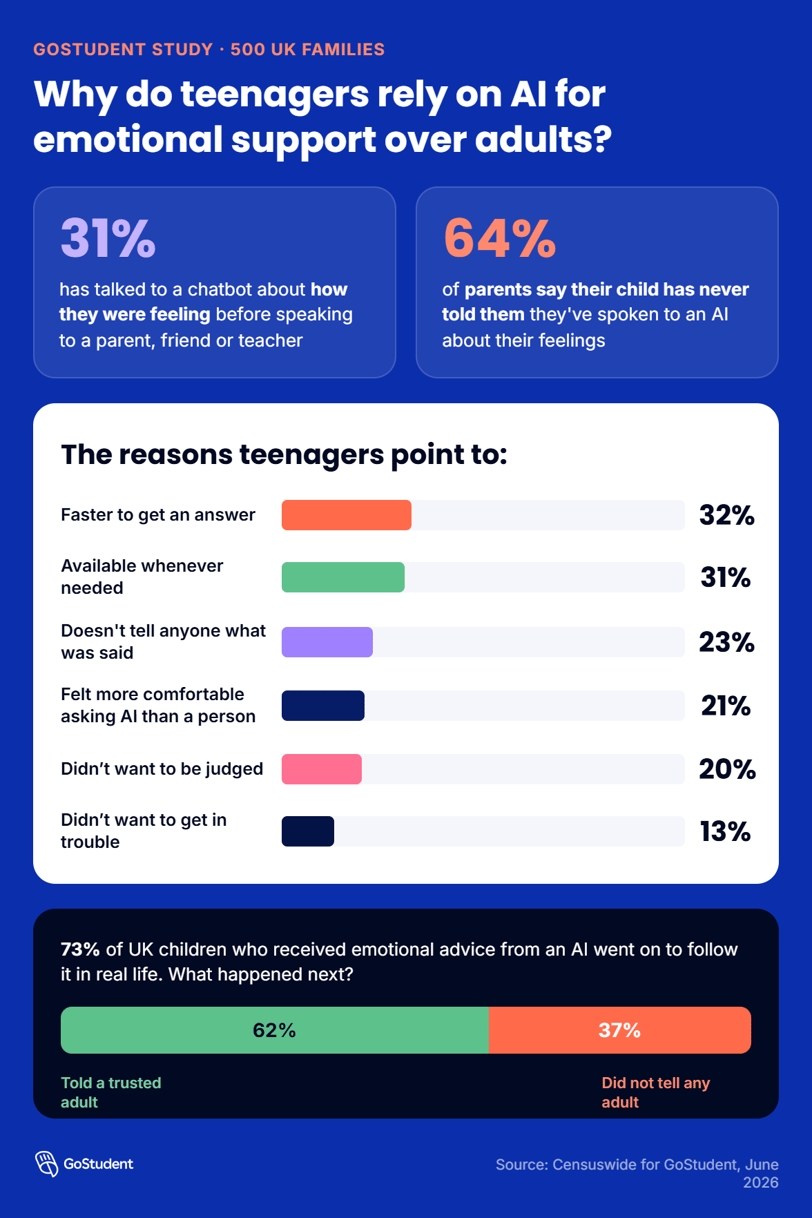
73% of children who'd received emotional advice from a chatbot said they went on to follow that advice in real life. More than a third did so more than once.
|
Followed AI advice about feelings in real life? |
Share |
|
Yes, more than once |
36.5%. |
|
Yes, once |
36.5%. |
|
No, never |
21.7%. |
|
N/A - I have not used an AI chatbot for this |
3.7% |
|
Prefer not to say |
1.6% |
Of the children who acted on that advice, we then asked whether they told a parent, carer or teacher about it.
|
Told a trusted adult after following AI advice? |
Share |
|
Yes |
62.4%. |
|
No |
37.1%. |
Read those two tables together and a clearer picture forms. Most children who follow a chatbot's advice do eventually loop in an adult, which is reassuring. But more than a third don't. That's a sizeable group of young people making real-life decisions, about how to handle a friendship, an argument, or their own low mood, based on advice from a chatbot, with no adult checking whether that advice was sound.
It's the difference between a chatbot suggesting "try writing down how you feel before bed" (harmless) and a chatbot's suggestion shaping how a teenager handles a genuinely difficult situation with no second opinion at all.
Why a chatbot instead of a teacher or parent
We asked children directly: when you have a question you could ask a teacher or parent, why choose an AI chatbot instead? They could select up to three reasons.
|
Reason for choosing an AI chatbot over a person |
Share |
|
Faster to get an answer |
32.1%. |
|
Available whenever needed |
30.6%. |
|
Doesn't tell anyone what was said |
22.5%. |
|
Felt more comfortable asking AI than a person |
20.5%. |
|
Didn't want to be judged |
19.9%. |
|
Gives more helpful answers than a person |
15.7%. |
|
Didn't want a parent or teacher to worry |
14.6%. |
|
Didn't want to get in trouble |
13.1%. |
|
I do not have a main reason for this (but I do use an AI chatbot for this) |
3.3% |
|
Prefer not to say |
2.0% |
|
Other, please specify |
0.5% |
Speed and availability lead the list, which is unsurprising; a chatbot doesn't have a bedtime or a staffroom to be in. But look further down. Nearly a quarter of children chose AI specifically because it doesn't tell anyone, and one in five said they simply didn't want to be judged.
That combination, always available, never judges, keeps a secret, is precisely what makes an AI chatbot for emotional support so appealing to a teenager who's anxious about how a real person might react. But it's also exactly why a chatbot is a poor substitute for one. It removes the very friction, a raised eyebrow, a gentle follow-up question, that often protects a child from acting on bad advice unchecked. And 14.6% of children chose AI specifically because they didn't want a parent to worry. That worry isn't a flaw in a parent's response; it's usually what drives them to actually step in and help.
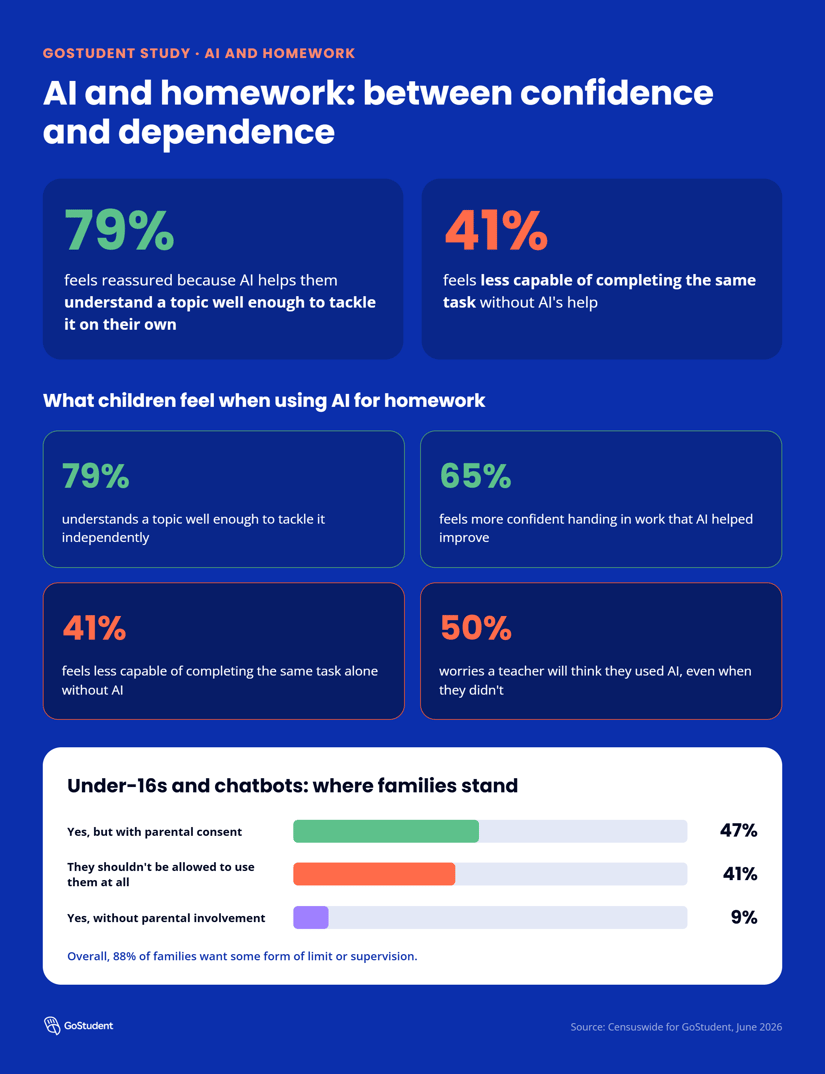
AI and schoolwork: confidence and its flip side
Chatbots aren't only used for feelings. We also asked children who'd used AI before how often, if at all, they identified with five statements about AI and schoolwork specifically.
|
Statement |
Often/Always combined |
|
Feels at ease because AI helps them understand topics well enough to tackle independently |
37.3%. |
|
Feels more confident handing in work because AI helped improve it |
30.1%. |
|
Feels confident their teacher will trust the work is their own |
59.8%. |
|
Feels less capable of completing the same task alone without AI (e.g. in an exam) |
15.1%. |
|
Feels anxious their teacher will think they used AI even when they didn't |
15.7%. |
There's a genuine paradox sitting inside this table. On one hand, most children feel AI helps them understand a topic well enough to eventually manage it on their own, and a majority are confident their work still reads as their own. That's the encouraging side of teenagers using AI chatbots for schoolwork; used well, it can build understanding rather than replace it.
But roughly one in six children at least often feels less capable of doing the same task alone, for example under exam conditions. And a similar share often feels anxious about being wrongly accused of using AI, even when they didn't. So the same tool that builds confidence for one child is quietly eroding independence, or trust, for another. It's not a clear-cut win or loss; it depends heavily on how, and how much, a child leans on it.
What parents see, and what they miss
Here's where the study's most uncomfortable gap shows up. We asked parents directly whether their child has ever told them about speaking to a chatbot about their feelings or personal problems.
|
Has your child ever told you they've spoken to an AI chatbot about their feelings? |
Share of parents |
|
Yes, more than once |
13.4%. |
|
Yes, once |
21.8%. |
|
No, never |
63.6%. |
Only 35.2% of parents have ever been told this by their child, directly, in conversation. Compare that with the 31% of children who told us they've used a chatbot about their feelings before speaking to a person at all, and the picture is stark: a large share of what's happening on a teenager's phone simply never reaches their parent's awareness.
This isn't necessarily children hiding things deliberately. It's more likely that a quiet late-night chatbot conversation just never comes up naturally, in the way a school trip or a friend's birthday party does. But the effect is the same: most parents are working with a significantly incomplete picture of how their child uses AI.
How parents feel, and what worries them most
We asked parents to imagine finding out their child had spoken to a chatbot about their feelings before coming to them or a friend.
|
How would you mainly feel? |
Share |
|
Concerned about the content/safety of the advice received |
42.2%. |
|
Concerned about their child's ability to connect with real people |
30.4%. |
|
Relieved they found a way to work through their emotions |
14.2%. |
Concern outweighs relief by a wide margin, over 72% land on one of the two worried responses, and open text answers reinforced this, with one parent writing they'd feel "concerned but also ok with them trying ChatGPT, so a mix of both", and another saying they'd want to understand "why they feel in such a way."
We then asked what concerns parents most about children using AI chatbots for personal or emotional advice, and the results were unusually close together, no single fear dominates.
|
Main concern |
Share |
|
Children may become too reliant on AI |
21.2%. |
|
Children may follow inaccurate advice |
20.0%. |
|
Children may stop talking to real people |
19.4%. |
|
Parents may not know what advice their child receives |
18.8%. |
|
Children may share personal information with a chatbot |
14.4%. |
That near-even spread tells its own story. Parents aren't fixated on one specific danger; they're worried about the whole shape of the problem at once, dependency, bad advice, isolation, privacy and their own blind spot, all roughly equally. It's a sign that using AI for emotional support as a child is a concern parents feel broadly, rather than one they've been able to pin down to a single fix.
Should under-16s use AI chatbots?
Finally, we asked parents for their overall view on children under 16 using AI chatbots such as ChatGPT.
|
View on under-16s and AI chatbots |
Share |
|
Should be allowed, but only with a parent's consent |
47.4%. |
|
Should not be allowed at all |
41.0%. |
|
Should be allowed without any parental involvement |
8.8%. |
Put those first two together and 88.4% of UK parents want some form of restriction on under-16s using AI chatbots, either an outright ban or a consent requirement. Barely one in eleven parents is comfortable with their child using a chatbot with no oversight at all.
That's a rare thing in a survey: near-consensus. Whatever else divides parents on screen time, homework habits or social media, on this question the vast majority land in the same place, children under 16 shouldn't be having these conversations completely unsupervised.

Staying in the conversation: what this means for families
None of this data suggests AI chatbots are inherently harmful, or that curious, resourceful teenagers should be discouraged from using new tools. Most of what children described, homework help, working through a tough day, figuring out how to word an email, is exactly the kind of everyday problem-solving young people have always needed support with.
The issue isn't the tool. It's the gap it can create between a child's inner world and their parent's awareness of it. Teenagers using AI chatbots for something as small as an email or as significant as a low mood at 11pm both point to the same underlying need: somewhere fast, private and non-judgemental to think out loud.
The most useful response isn't to remove that option, it's to make sure a trusted adult remains part of the loop too. Here's how:
- Ask open questions instead of closed ones. Swap "did you do your homework?" for "how did you end up doing that?" A question like "what did you use to help with the essay?" invites a teenager to mention AI naturally, rather than making them feel like they need to hide it.
- Treat "I asked AI" as an opening, not a red flag. If a child mentions using a chatbot, respond with curiosity rather than concern. Asking "what did it say, and what did you think?" keeps the conversation going and gives a parent a chance to gently check the advice, rather than shutting the topic down and pushing it underground.
- Make honesty cheaper than silence at home. Children choose a chatbot partly because they don't want to be judged or get into trouble. Reacting calmly to a difficult admission, a bad grade, a friendship problem, a low mood, makes it more likely they'll come to a parent directly next time, instead of defaulting to an app that never raises an eyebrow.
- Address the pressure driving the behaviour, not just the behaviour itself. School stress is the single biggest reason teenagers turn to a chatbot in the first place. Pairing a child with a patient, real online tutor can take the edge off that pressure directly, reducing the need for a 24/7 alternative that's always available but never actually checks in.
- Create space in the classroom for questions without judgement. Nearly one in five children said they avoid asking a teacher because they don't want to be judged, and 13% because they don't want to get in trouble. Teachers and tutors can counter this by normalising "I don't understand" as a normal part of learning, not a failure, and by making it clear that asking for help, about a tricky topic or a tough week, never reflects badly on a student.

Some final thoughts on children relying on ai for emotional support
Teenagers aren't turning to AI chatbots because they've stopped needing people. They're turning to them because, in that moment, a chatbot is what's within reach, and a trusted adult sometimes isn't.
What this study really shows is a gap, not a crisis. Most children aren't in danger when they ask a chatbot for help with an essay or a bad day. But when over a third of them act on emotional advice without telling anyone, and most parents have no idea any of this is happening, that gap deserves attention.
The good news is that closing it doesn't take anything dramatic. It takes noticing when a child mentions AI and gently leaning in instead of moving on or reacting negatively. It takes making space for the ordinary, unremarkable conversations, about school, about friends, about a rough day, so a chatbot doesn't end up being the only place those conversations happen. Small, steady attention like that is what keeps a parent (and a teacher) part of the picture, long before anything serious is at stake.


.jpg?upsize=true&upscale=true&width=100&height=100&name=math-square-root%20(1).jpg)