
Did you know that UK children are the most optimistic in Europe about their own future, at 67%, yet only 41% of their parents would support banning smartphones in school outright, the lowest figure of any market surveyed? Or that among students already using AI for homework, 73% admit to submitting it as their own work? These numbers, drawn from our six-country European study, raise a simple question: is school actually keeping pace with the world today’s children are growing up in?
That’s exactly what this education report sets out to explore: understanding how education is evolving, and weighing up what students, teachers and parents each think is working well, what needs adjusting, and how best to prepare the next generation for what’s coming. Asking the people living this every day, rather than relying on assumptions about “kids and screens” or an AI that “changes everything,” gives a far more accurate picture of what’s actually needed, and where. This 2026 edition draws on responses from 3,001 parents and their 3,001 children, alongside 300 teachers, surveyed across six European countries.
For the UK specifically, GoStudent surveyed 500 parents and their 8-16 year olds, alongside 50 teachers. The findings paint a country more confident about the future than any of its European neighbours, yet one where 83.6% of parents are satisfied with their child’s education while only 65.6% believe it’s actually preparing them for life after school, a gap that runs through almost everything this report found.
📌 Key figures at a glance:⚪ 83.6% of UK parents are satisfied with the education their child currently receives. ⚪ Yet only 65.6% believe that education is actually preparing their child for life after school. ⚪ Just 41% of UK parents back a total smartphone ban in schools, one of the lowest rates of any market surveyed, behind only Germany. ⚪ 32.8% of UK parents think schools, not parents, should be primarily responsible for teaching responsible AI use. ⚪ 73% of students who use AI for schoolwork have submitted AI-generated content as their own, and that’s before accounting for how unreliable AI-detection tools still are. ⚪ 65% of UK students say they’re confident they could spot a deepfake image or video, yet only 56.2% of their parents feel the same about their child’s ability to do so. |

Methodology
This education report draws on fieldwork carried out by GoStudent with Censuswide, a member of the Market Research Society (MRS) and the British Polling Council (BPC). In total, 3,001 parents and their 3,001 children aged 8 to 16 were surveyed across six European countries, alongside 300 teachers. In the UK specifically, 500 parents and their 500 children were surveyed online between 26 June and 10 July 2026, alongside 50 teachers. The same methodology was applied in Austria, Germany, Spain, France and Italy, allowing direct cross-market comparison. The full dataset sits in our complete Education Report 2026.
The UK’s Alpha generation: 67% optimistic, the highest in Europe
Generation Alpha, the first generation raised entirely alongside AI and smartphones, is growing up in a world its parents never experienced: constant connectivity, AI a tap away, and a news cycle that fuels both resilience and anxiety in equal measure. Before getting into school policy or AI specifically, it’s worth looking at how these young people see their own future, and how their parents read that same picture.
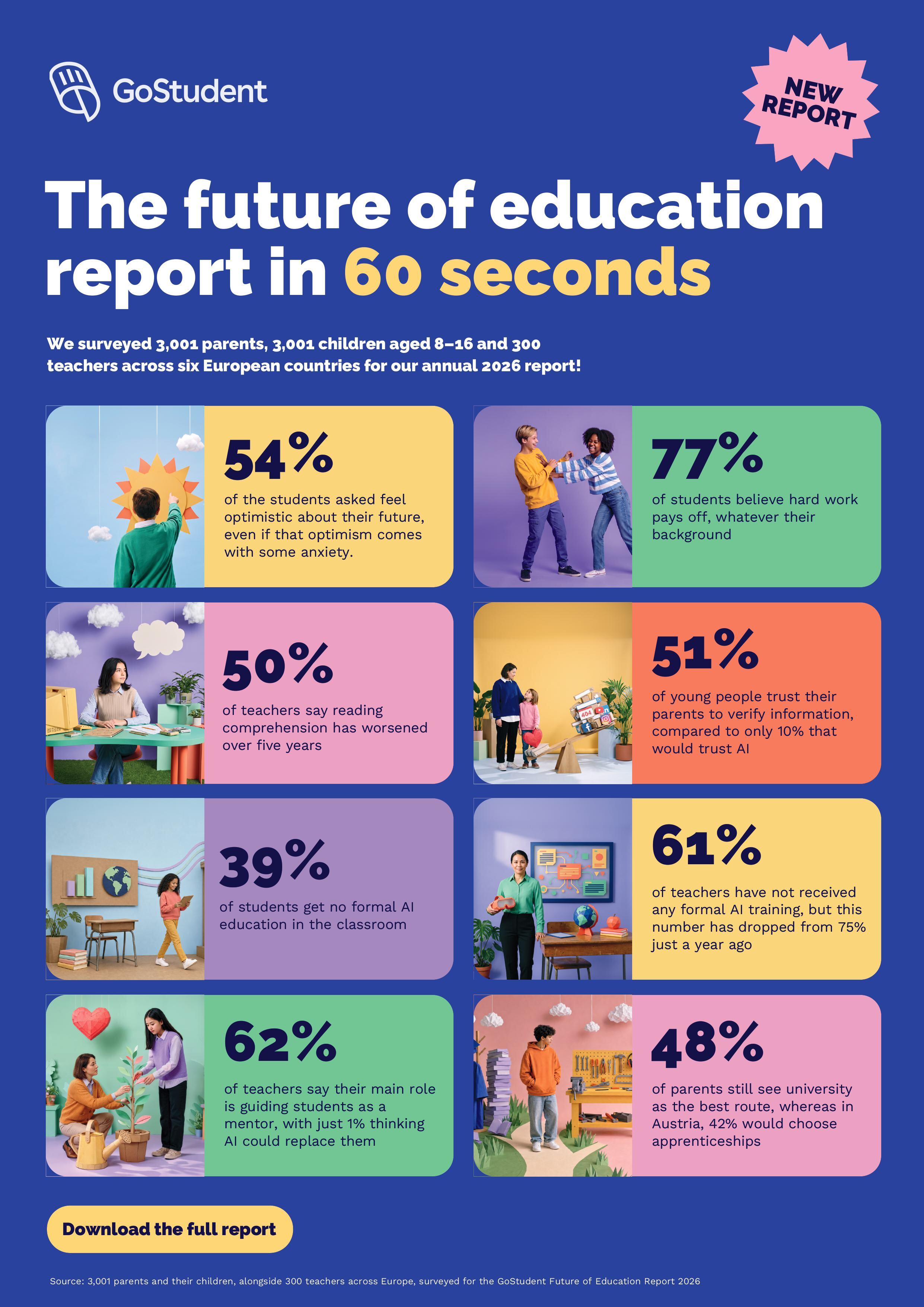
British children are, by some distance, the most optimistic in Europe about their own future: 67% describe themselves as broadly positive, well ahead of the six-market average of 53.8% and nearly 20 points clear of France’s 45.6%.
|
Metric |
6-country average |
AT |
DE |
ES |
FR |
IT |
GB |
|
Young people optimistic about their future |
53.8% |
46.2% |
55.5% |
52.8% |
45.6% |
56% |
67% |
|
Parents backing a total smartphone ban |
52% |
52% |
39% |
63% |
58% |
60% |
41% |
|
Parents who feel their child is prepared for life after school |
47% |
45% |
44% |
41% |
39% |
36% |
66% |
“A teenager can be proud of their parents’ career and, at the same time, not want that kind of life for themselves. We see big ambitions, but also real fear of what they might have to sacrifice to achieve them.”
- Giuseppe Lavenia, psychologist and researcher in work and organisational psychology, Marche Polytechnic University
Screen time still worries most households (56.8% say their child spends too much time on screens), but relatively few call it “far too much” (10.6%), a notably calmer read than in France, where one in five parents use that strongest category.
|
🔎 67% of UK students feel optimistic about their future, the highest rate of any country in GoStudent’s Education Report 2026, compared with a six-market average of 53.8%. |
Zoom: screen time, UK parents are widely concerned but rarely alarmed
The topline figure only tells half the story. Looking at the full breakdown shows that UK parents aren’t necessarily more relaxed about screens than other markets, they’re just less likely to reach for the most extreme label when describing it. That distinction matters: a household worried about “slightly too much” screen time calls for a very different conversation than one that feels it’s gotten completely out of hand.
|
Screen time view |
UK parents |
FR parents |
|
Far too much |
10.6% |
21.2% |
|
Slightly too much |
46.2% |
34.8% |
|
Too much (total) |
56.8% |
56.0% |
|
About the right amount |
39.6% |
35.0% |
|
Too little (total) |
3.2% |
7.6% |
The two countries land on almost the same overall “too much” figure, but the shape of that concern is very different. In France, one in five parents reach for the strongest category, “far too much”, whereas in the UK that figure is barely one in ten, with most concerned parents instead choosing “slightly too much”. UK parents also report feeling broadly reassured more often: nearly 40% say screen time is “about right”, against 35% in France. Taken together, British parental anxiety about screens reads as wide but shallow, rather than the sharper, more acute worry seen across the Channel.

Zoom: deepfakes, teens are more confident than their parents give them credit for
There’s a real gap between how capable UK teenagers feel and how capable their parents think they are. 65% of UK students say they’re confident they could spot a deepfake image or video, the highest self-reported confidence of any market in the study, yet only 56.2% of UK parents feel the same about their child’s ability to do so. It’s a small but telling mismatch: the generation actually navigating a feed full of AI-generated content rates itself higher on media literacy than the adults watching from the outside.
Zoom: what Generation Alpha actually believes about getting ahead
Beyond school and screens, this generation has a fairly clear-eyed view of what matters in life. Across the six markets studied, young people lean firmly toward personal wellbeing over grades (50.4% vs 28%), and toward a job they’d actually enjoy over one that simply pays well (49.8% vs 29.9%), EU-wide figures with no UK-only breakdown available, but still a useful backdrop for the UK’s own numbers. Locally, 77.9% of UK students believe that hard work pays off regardless of background, among the highest of the six countries and further proof that this generation’s optimism isn’t naive, it’s paired with a genuine belief in effort.
AI in UK classrooms: 73% of pupils pass off AI homework as their own
If AI fascinates as much as it worries parents, it’s because its status has shifted within months: a curiosity not long ago, it’s now a tool roughly half of students already use for homework, often with little structure or training behind it. The open question is who, school, parents or government, should actually be responsible for getting that right.
UK parents are notably more comfortable with AI overall than their French counterparts: 56.4% describe their perception of it as positive, against 49% in France. That comfort extends to how AI is being taught: 60% of UK parents say their child has had some formal instruction on AI at school, compared with 42.8% in France, and 52.6% of UK parents believe government is doing enough to set clear rules on AI in schools, more than in any other market surveyed.
|
🔎 73% of UK students have submitted AI-generated content as their own work, the highest rate among the six countries in GoStudent’s Education Report 2026, and that’s before accounting for how unreliable AI-detection tools still are. |
Zoom: who should teach AI responsibly?
This is one of those questions where everyone has an opinion, but rarely the same one. Parents, schools, tech companies and government have all been floated as the right party to take the lead, and where people land often says as much about who they trust as it does about who they think is best equipped. Here, the UK actually stands apart from the rest of Europe entirely.
Asked who should be primarily responsible for teaching children to use AI responsibly, UK parents lean toward schools:
|
Who should be responsible |
UK parents |
Teachers (Europe average) |
|
Schools |
32.8% |
45% |
|
Parents |
28.0% |
26% |
|
Tech companies |
14.0% |
13% |
|
Government |
6.0% |
10% |
This is actually one of the few places where UK parents and teachers broadly agree, both point to schools first, ahead of parents. That makes the UK the outlier of the study: in every other market surveyed, parents rank themselves as the top choice instead, most strongly in Germany (46.5%) and Austria (39.4%), and even in Spain, where the gap between parents and schools is the narrowest (32.0% vs 30.8%).
|
Country |
Parents |
Schools |
|
Germany |
46.5% |
24.0% |
|
Austria |
39.4% |
27.2% |
|
Italy |
39.4% |
33.6% |
|
France |
33.6% |
26.4% |
|
Spain |
32.0% |
30.8% |
|
United Kingdom |
28.0% |
32.8% |
France sits closer to the Spanish pattern than the UK’s, with parents still narrowly ahead (33.6%), but a genuine disagreement underneath that number, since French teachers favour schools instead.

The school of tomorrow: 83.6% satisfied, only 65.6% prepared
Beyond AI, it’s the wider shape of the curriculum that UK families are questioning: which subjects still earn their place, which need a rethink, and what school actually needs to prepare a child for once they leave it.
The UK shows the starkest version of a paradox seen across Europe: 83.6% of parents are satisfied with their child’s current education, yet only 65.6% believe that education is actually preparing their child for life after school. Even with that gap, the UK still sits well ahead of every other market surveyed, including France (39.2%).
Zoom: what to add to the curriculum, and what to rethink
Ask a parent what school should actually be teaching and the answers go well beyond the usual subject list. Curriculum debates tend to focus on protecting “core” subjects, but UK parents are just as vocal about what’s missing as they are about what feels outdated. Taken together, their priorities point to a clear preference for practical, future-facing skills over purely academic ones.
Subjects UK parents would like to see added to the curriculum:
|
Subject to add |
% of parents in favour |
|
Financial planning and management |
46.6% |
|
AI and machine learning |
41.0% |
|
Technology development |
39.0% |
|
Cybersecurity |
36.2% |
By contrast, here are the subjects most commonly seen as no longer fit for purpose:
|
Subject to rethink or cut |
% of parents who agree |
|
Religious education |
24.2% |
|
Music |
17.4% |
|
Spanish |
16.9% |
|
Italian |
15.7% |
Financial planning tops the wish list by a wide margin, well ahead of AI itself, a clear signal that UK parents see money skills, not just tech skills, as the bigger gap in today’s curriculum.
Zoom: the skills that matter most for the future
Asked which human skills will matter most as AI becomes more prevalent, UK students themselves rank problem-solving (28.4%), communication (26.4%), creativity (23.4%) and critical thinking (23.2%) at the top, within a few points of each other. It’s a reminder that students aren’t just thinking about technical skills, but about the human capabilities a machine can’t easily replace.
Mental health support reads far more positively here than elsewhere: 69.4% of students and 68% of parents agree their school does enough on this front, against roughly 43% on both counts in France.
“AI can help make learning more accessible, but inclusion isn’t just about access to information. Relationships, belonging and understanding each learner remain essential, and technology should strengthen those parts of education rather than replace them.”
- Mark Avery, Senior Lecturer in Education at the University of the West of England (UWE), Bristol
Zoom: University vs. vocational training, the UK leans harder toward university than France
For all the public debate around apprenticeships and alternative routes into work, the question of what parents actually want for their own child tends to be more revealing than what they say in the abstract. Ranking exercises are useful here precisely because they force a genuine trade-off, rather than letting every option sound equally appealing. When UK parents make that choice, one path stands out clearly ahead of the rest.
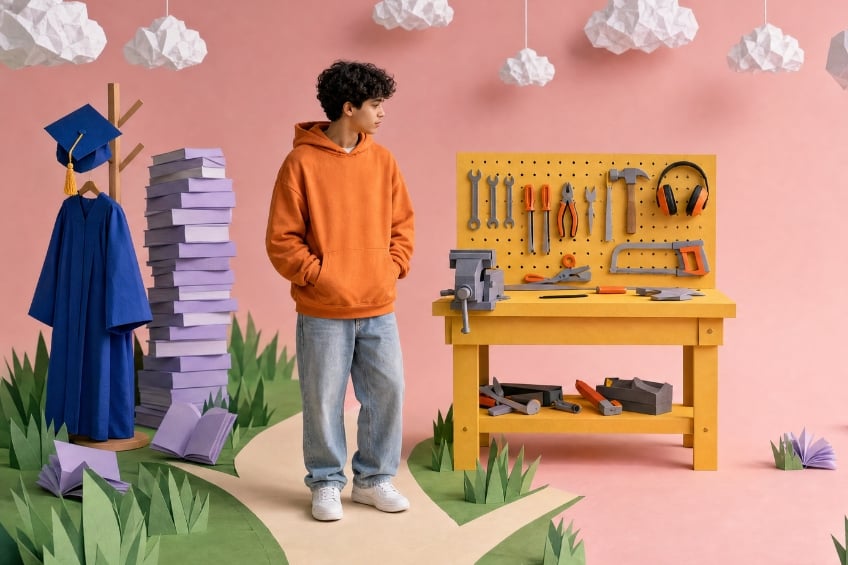
When asked to rank their preferred path for their child’s future, UK parents put university degrees clearly in first place, more decisively than French parents do.
|
Path |
UK: ranked 1st |
FR: ranked 1st |
|
University degree |
46.9% |
43.5% |
|
Apprenticeship or vocational training |
31.5% |
31.9% |
|
College or further education course |
21.6% |
24.6% |
(Lower mean rank = stronger overall preference. Based on parents who expressed a ranked preference: 426 in the UK, 398 in France.)
First-choice support for apprenticeships is almost identical in both countries (31.5% UK vs 31.9% FR), so the real gap sits elsewhere: UK parents are notably more likely to rank university first and college-style routes last, while French parents spread their preference a little more evenly across all three paths. Despite years of UK policy debate pushing apprenticeships as a genuine alternative, parental preference hasn’t shifted as much as that debate might suggest.
Why this matters, and what’s coming next
Behind every one of these numbers sits a question GoStudent asks itself every year this study runs: is school evolving as fast as the world it’s meant to be preparing children for? Asking families directly, rather than relying on assumptions about “screen time” or an AI that “changes everything,” gives a far more honest read of what people actually expect, fear and agree on.
What this year’s UK edition shows is a country more confident about the future than most of its European neighbours, yet still working out exactly where responsibility for AI literacy should sit, and how to close the gap between that confidence and classroom reality.
This article is only a first look at what the full report contains. Over the coming weeks, we’ll publish deeper dives into specific themes, from how AI is really being used in homework to the future of assessment and student mental health. Follow this series for the fuller picture of what our study reveals about the future of education.
How to cite this reportFeel free to reuse the data in this article, crediting the source and linking back to this page: Source: GoStudent Education Report 2026 (UK). Charts and visuals from this report may be reused with credit to GoStudent and a link to the full report page. |
Sources |